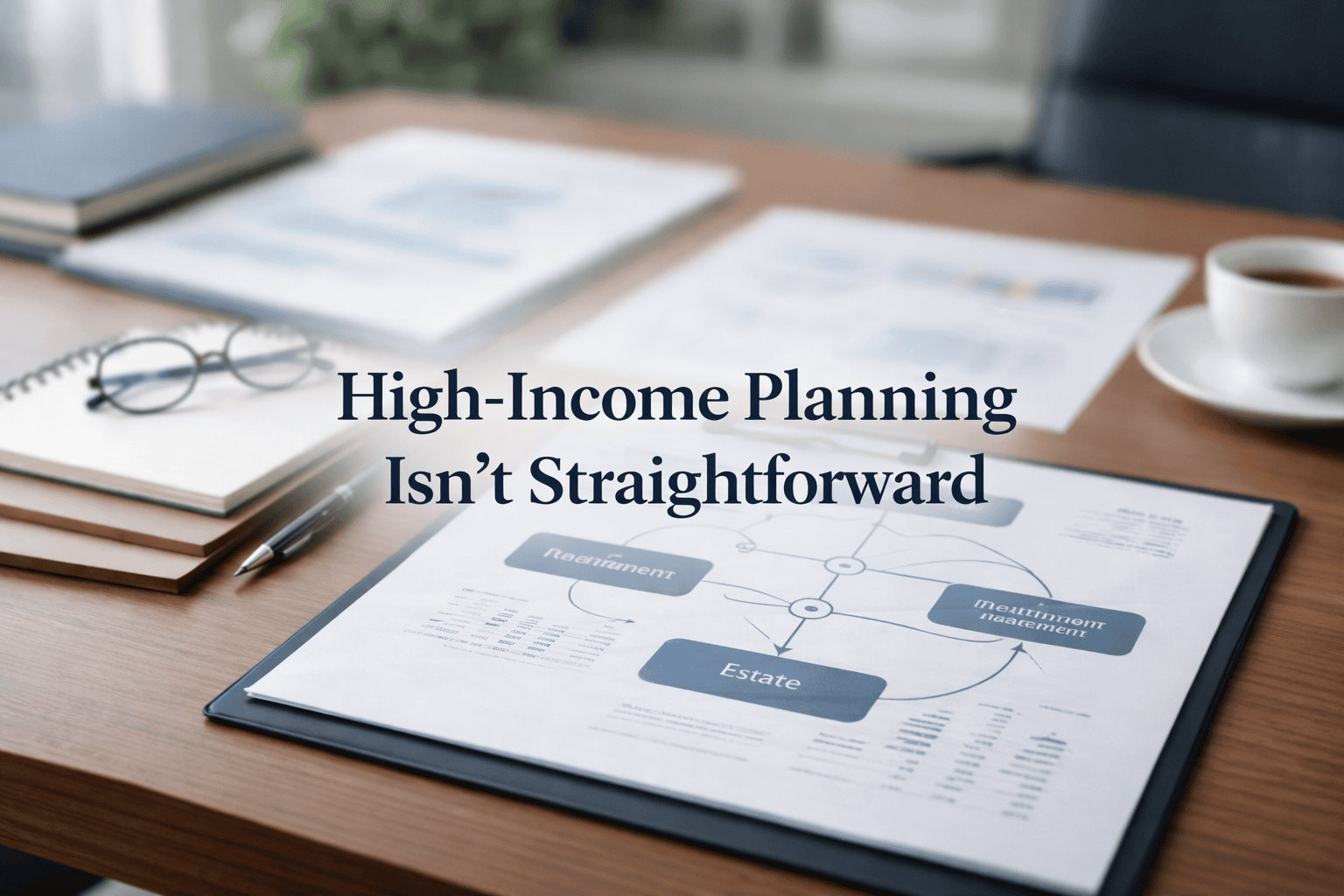
High-income business owners often spend years building a business - and relatively little time structuring the wealth that comes from it. Standard retirement vehicles like 401(k)s and IRAs have contribution limits that become increasingly irrelevant as income grows, and they expose a growing share of dollars to tax inefficiency.
This guide covers why common retirement approaches fall short at higher income levels, and what more coordinated planning looks like in practice.
Wealth Management Strategies for High-Net-Worth Individuals
Managing a business and managing personal wealth are different disciplines. High income doesn't automatically translate to financial security - without structured planning, wealth erodes through taxes, inflation, and decisions made without a complete picture.
A few approaches worth building around:
Tax-efficient investment structuring places tax-inefficient assets (such as bonds generating ordinary income) inside tax-deferred accounts, and tax-efficient assets (such as index funds with lower turnover) in taxable accounts. The goal is preserving after-tax growth across the full portfolio - not just optimizing each account in isolation.
Risk management at this level typically goes beyond standard diversification. It includes insurance structures, asset protection layers, and coordinated reviews as net worth and business complexity grow.
Capital preservation becomes its own discipline post-accumulation. Diversified holdings across asset classes, disciplined distribution planning, and clear visibility into concentrated positions all matter here.
Estate Planning for Business Owners
Without deliberate planning, the default outcomes for a business owner's estate are rarely optimal - for heirs or for the IRS bill the estate produces.
The core tools are well-established: irrevocable trusts can reduce taxable estate value and provide structured control after death. Succession planning ensures there's a clear path for the business itself - whether that means a family transfer, a key executive transition, or a planned sale. Charitable structures like Donor-Advised Funds and Charitable Lead or Remainder Trusts can align philanthropic goals with tax efficiency.
The challenge isn't knowing these tools exist. It's coordinating them - making sure the estate attorney, CPA, and financial advisor are working from the same picture rather than each optimizing their own piece independently.
The Role of a Virtual Family Office
A Virtual Family Office (VFO) is a coordinated advisory model that integrates tax planning, estate planning, investment oversight, and risk management through a network of specialists. Unlike working with individual advisors in separate relationships, a VFO structure keeps all of those disciplines aligned around a single financial picture.
For high-income business owners, the practical value is in that coordination. Asset protection planning, multi-generational wealth transfers, and tax strategy all intersect - decisions in one area affect the others. When the professionals handling each area communicate, that intersection gets managed intentionally rather than left to chance.
Collective VFO works alongside your existing CPA and advisors rather than replacing them. We coordinate the strategy and implementation process - licensed professionals handle the regulated work.
Tax-Efficient Retirement Planning
Retirement planning at higher income levels is less about contribution limits and more about structuring assets across different tax treatments.
A few principles that hold across most situations: balancing holdings across taxable, tax-deferred, and tax-free accounts creates distribution flexibility later. Roth conversions in lower-income years - before a business sale, for example, or before required minimum distributions begin - can reduce long-term tax exposure. Capital gains timing and tax-loss harvesting both matter, though their impact compounds when coordinated with entity-level decisions rather than managed in isolation.
For business owners specifically, defined benefit and cash balance plans can allow substantially higher annual contributions than a 401(k) alone - often $100, 000 to $300, 000+ annually depending on age and compensation structure. These plans require actuarial design and ongoing compliance work, but the tax impact can be significant for owners in high-earning years.
Wealth Preservation
Building wealth and preserving it require different disciplines. The risks that matter most at higher net worth levels - litigation exposure, estate tax, concentrated positions, long-horizon tax drag - are different from the accumulation risks that dominated the building phase.
The structures that address these: entity design (holding companies, multi-entity structures for liability separation), insurance coverage sized appropriately to actual exposure, trusts that place assets outside the taxable estate while maintaining family access where needed, and regular reviews as the picture evolves.
No single structure addresses all of it. What matters is that someone is looking at the full picture on a consistent basis - not just responding to events as they arise.
FAQ
Where Collective VFO Fits
What we coordinate: Tax, estate, and retirement strategy across your CPA, attorney, and financial team - from entity structure through distribution planning.
Next step: Start with a short conversation →
Collective VFO facilitates strategic coordination across tax, legal, and financial planning disciplines. We do not provide legal, accounting, securities, or investment advisory services directly. Any such services are provided by appropriately licensed professionals. The content in this article is for educational purposes and does not constitute financial, legal, or tax advice. For guidance specific to your situation, consult a licensed professional.