
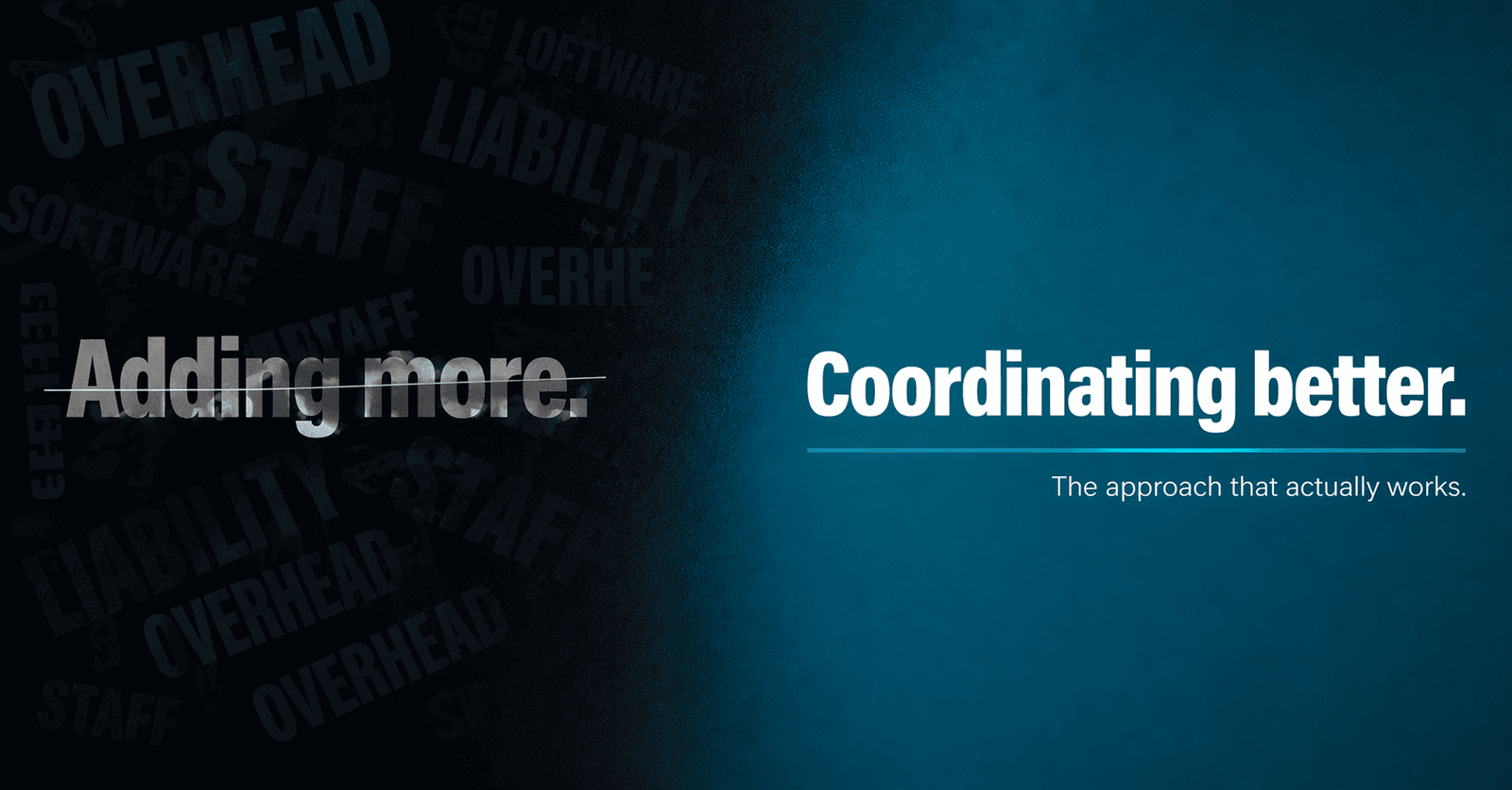
When CPAs start thinking seriously about becoming more proactive, most of them arrive at the same conclusion: the answer must be adding more.
More services. More expertise. More staff. A broader offering that lets them handle more of what their clients need without sending them elsewhere.
It's a reasonable assumption. It's also the wrong move for most firms.
The overhead trap
Here's what actually happens when a CPA firm tries to expand its service offering in the name of becoming more advisory. They hire a financial planner. They bring in an estate attorney on retainer. They invest in new software platforms. They send staff to training programs. They spend six months building out infrastructure - and then they discover the problem.
The overhead arrives immediately. The revenue takes years.
Meanwhile, they're still running the compliance treadmill that prompted the whole initiative in the first place. They haven't escaped the cycle. They've just made it more expensive.
The firms that successfully make the shift to proactive planning don't solve the problem by adding more. They solve it by thinking differently about what their role actually is.
The coordination model
The most effective CPA firms in a proactive planning model aren't the ones who know the most or offer the most. They're the ones who coordinate the best.
Their clients - business owners, high-income professionals, families with complex situations - don't need one advisor who does everything. They need a team of specialists working together, with someone at the center making sure nothing falls through the cracks.
That's the CPA's role in a proactive model. Not to be the expert in everything. To be the person the client calls first - and the person who makes sure the right experts are working together on their behalf.
This reframe changes everything about how a firm needs to build.
You don't need to hire a financial planner. You need access to a vetted network of financial planners. You don't need an in-house estate attorney. You need a relationship with estate attorneys who can be brought into a client situation when it's warranted. You don't need to become an expert in business exit planning. You need to recognize when a client is approaching an exit and know exactly who to call.
The CPA stays at the center of the relationship. The specialists rotate in and out based on what each client needs at each stage.
What this requires
The coordination model sounds straightforward. In practice, it requires three things most CPA firms don't currently have.
The first is a process for identifying which clients have planning needs - and what those needs are - before the client brings them up. This is the diagnostic layer. Without it, you're still reactive. You're waiting for clients to tell you they're thinking about selling the business instead of asking the right questions two years earlier.
The second is a specialist network you actually trust. Not a list of referral contacts you met at a conference. A working group of professionals who understand how to collaborate inside a coordinated planning engagement - who communicate, who meet deadlines, and whose work integrates with yours rather than running in parallel to it.
The third is the coordination infrastructure itself. Someone has to manage the engagement. Someone has to make sure the estate attorney and the financial planner and the CPA are all working from the same strategy. Someone has to follow up, schedule, document, and keep things moving. Without this, the coordination model breaks down into a referral model - and referral models don't deliver the client experience that justifies advisory-level fees.
Where the leverage is
The reason the coordination model is more valuable than the expanded-services model isn't just that it's cheaper to build. It's that it's better for clients.
A CPA who tries to do everything herself will always be constrained by her own bandwidth and expertise. A CPA who coordinates a team of specialists around her best clients can deliver an outcome that no single advisor could produce alone.
The business owner who is planning a company exit in the next three years doesn't just need a good tax return. They need a multi-year income strategy, an entity structure review, an estate plan that accounts for the transition, an investment strategy that accounts for a large liquidity event, and someone coordinating all of it so the pieces fit together. No single advisor can provide all of that. But a well-coordinated team can.
The CPA who positions herself as the quarterback of that team - the trusted advisor who brings in the right people at the right time and makes sure everything integrates - is worth far more to that client than any individual specialist. And she gets compensated accordingly.
What this looks like in practice
At Collective VFO, this is the model we've built. We work alongside CPAs - not replacing them and not operating independently of them. The CPA maintains the client relationship. We provide the process, the specialist network, and the coordination infrastructure.
The CPA introduces a client to our team when there's a planning opportunity. We lead the diagnostic process, build the strategy, coordinate the specialists, and manage implementation. The CPA stays involved at key decision points and remains the primary relationship for the client.
It doesn't require the CPA to become something she isn't. It doesn't require new hires or new software or new service lines. It requires the right partnership and a willingness to think about the role differently.
If you've been assuming that a more proactive practice means a bigger, more complex firm - this is the alternative worth considering.
Where Collective VFO Fits
What we coordinate: The diagnostic process, specialist network, and implementation infrastructure that allows CPA firms to deliver coordinated proactive planning without expanding their own overhead.
Who this is for: CPAs with established client relationships who want to move toward a more advisory model - and want a partnership that handles the coordination layer they don't currently have.
Next step: Start with a short conversation →
Collective VFO is a proactive planning firm that coordinates tax, legal, estate, and business advisory work for high-net-worth business owners and families. We work alongside CPAs and advisors - not in place of them.